Shedding Light on Deep-Sea Mysteries: The Soft Seafloor Bottom of Monterey Bay National Marine Sanctuary
By sanctuaries.noaa.gov, sanctuaries.noaa.gov.
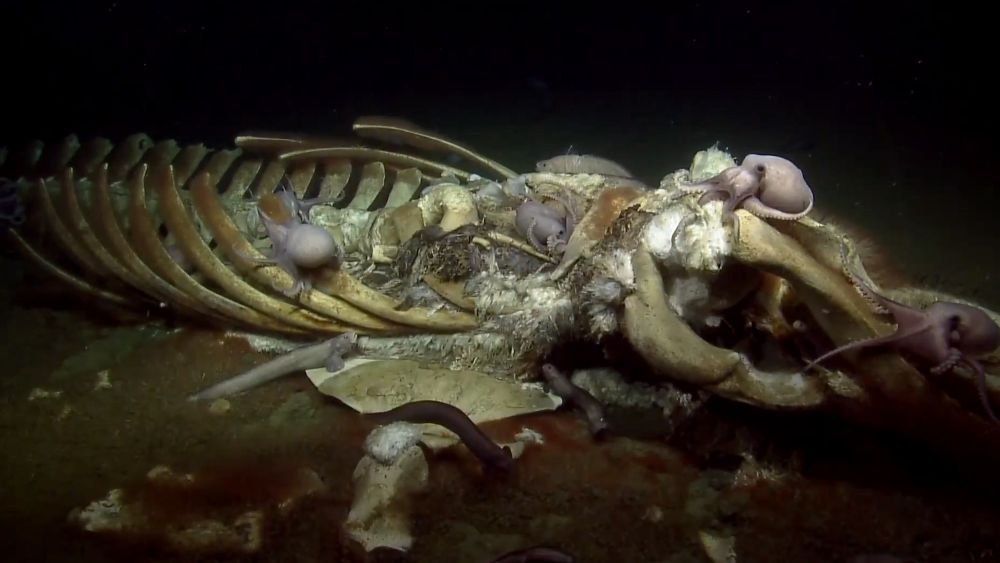
For locals and tourists alike, the beach is a popular destination. Sitting on the soft sand and watching the waves, shorebirds and marine mammals is good for the soul. Inquisitive beachgoers may find beach hopper insects near drift kelp or may dig up a few sand crabs at the water’s edge. But what is happening on the seafloor beyond the waves? There may be more sand, a rocky reef, deep canyons, or spectacular undersea mountains. Yet much of Earth’s habitable space lies in the dark, cold deep sea, where the seafloor is soft, flat, and muddy.
Few people have direct access to the seafloor at thousands of feet below the surface. Jim Barry, a senior scientist at Monterey Bay Aquarium Research Institute, has studied this habitat for the past 35 years using remotely operated vehicles. “It’s a fascinating place with surprising biological diversity,” Barry said. “Last month, we observed the rare bigfin squid drifting just above the seafloor. It was the first live sighting of this animal in the Northeast Pacific.”
Erica Burton, a research ecologist for Monterey Bay National Marine Sanctuary, has co-authored taxonomic guides to deep-sea organisms. “My favorite is the giant cusk eel. I enjoy watching how it slowly swims above the seafloor near other species in this ecosystem that we know relatively little about.”


Until the 1870s, many scientists believed that deep-sea areas were devoid of life. This idea, known as the azoic theory, proved dramatically wrong. The soft seafloor of the deep sea supports a surprisingly rich community of animals, far more diverse than the life we see on coastal beaches.
Read the full article here: Shedding Light on Deep-Sea Mysteries: The Soft Seafloor Bottom of Monterey Bay National Marine Sanctuary