New Satellite Tag Offers Longer Tracking of Baleen Whales
By fisheries.noaa.gov, fisheries.noaa.gov.
How do you track a 40-ton ocean giant without leaving a mark? Monitoring large whales is a delicate balancing act between science and safety. Satellite tags allow researchers to follow the movements of whales beyond where they can be seen. This helps us understand how whales overlap with human activity, so we can make informed conservation and management decisions. But the most durable and long-lasting tags come with a tradeoff: They implant into the whale’s muscle, which can sometimes negatively impact health.
Alexandre Zerbini, a leading expert on the development of satellite tags for large whales, is bridging this gap. He is a research scientist at the University of Washington’s Cooperative Institute for Climate, Ocean, and Ecosystem Studies and an affiliate at the Alaska Fisheries Science Center’s Marine Mammal Laboratory. With support from NOAA Fisheries and the U.S. Office of Naval Research, he and his research team developed a “blubber-only” tag. It passes through the whale’s skin but anchors into the blubber layer, stopping before it reaches lower tissue layers on the whale’s body.
“We have been after a blubber-only tag for quite some time, and we are excited that Alex and his collaborators have reached this important milestone,” said Eric Patterson, Cetacean and Pinniped Conservation Program Supervisor within NOAA Fisheries’ Office of Protected Resources. “Whales spend most of their lives underwater, so it’s incredibly challenging for us to track their larger-scale movements and migrations. Satellite tags provide critical data, and this new design produces better results than current implantable tags while being safe for the animals.”
Initial Testing on Southern Right Whales
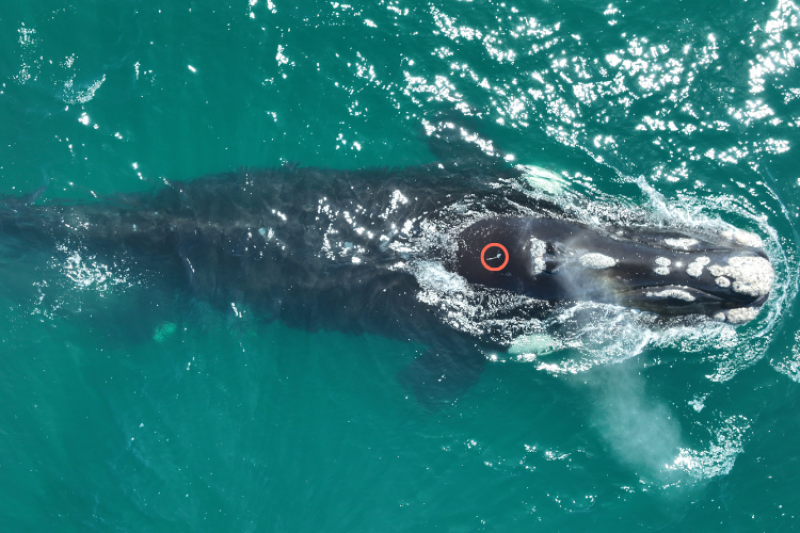
For the past several years, the research team has deployed the new tags on Southern right whales off the coast of Argentina. Southern right whales are closely related to endangered North Atlantic and North Pacific right whales, but their population is much larger. This makes them an ideal surrogate to test new tagging technology before applying it to at-risk species.