Spring vs. Neap Tides: What’s the Difference?
Spring and neap tides are the two ends of the tide’s two-week cycle. Spring tides come at the new and full moon, when the sun and moon line up and the tidal range is at its biggest: higher highs, lower lows. Neap tides come at the quarter moons, about a week later, when the range is at its smallest.
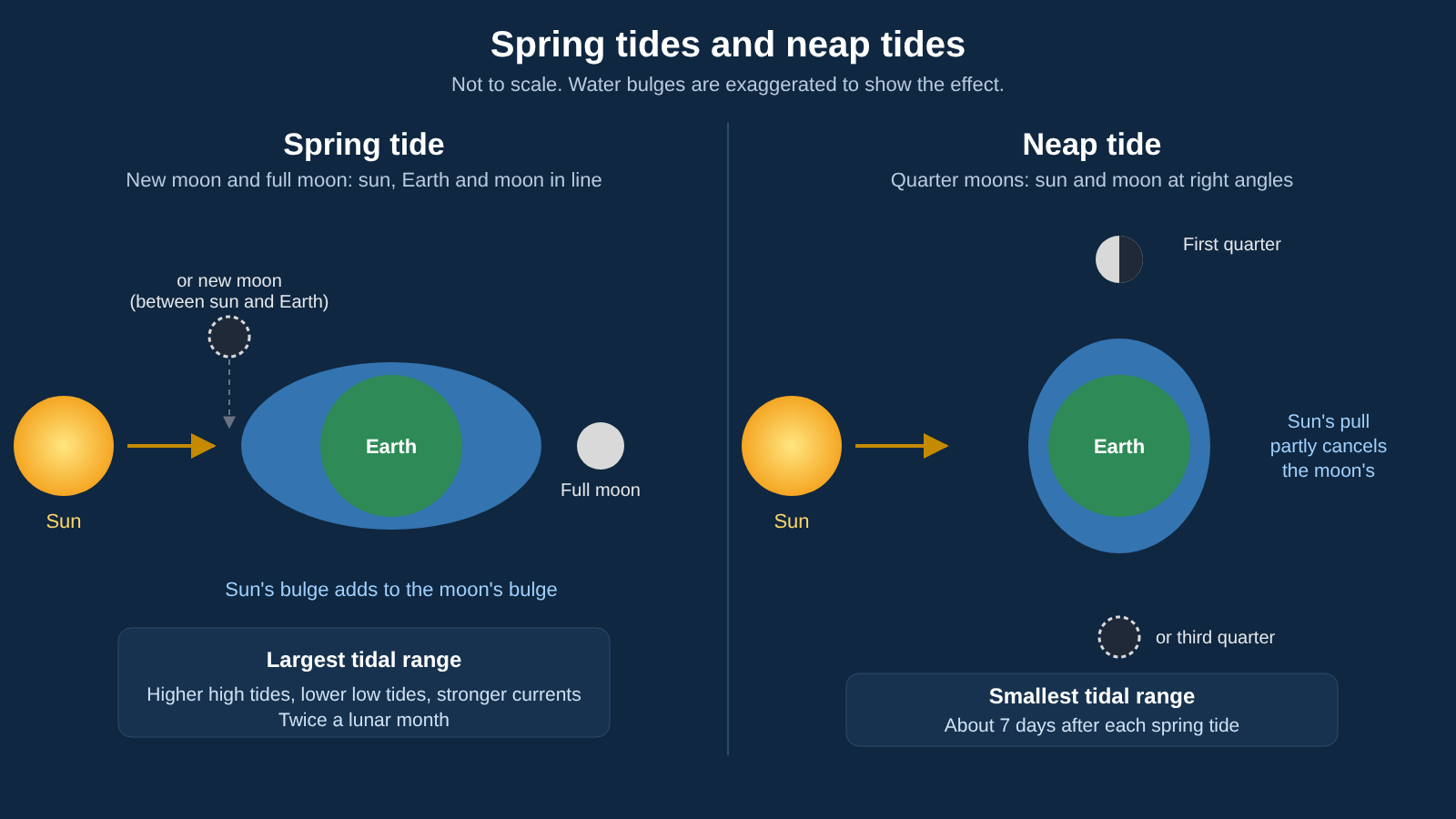
The name has nothing to do with the season. “Spring” is an old word for the tide springing up, and spring tides happen twice a month, all year long.
You can see the difference on any of our harbor pages. At [CHECK: harbor name, linked to its US Harbors page], the full moon week of Nov. 22 to 26 brought a high of [CHECK: highest high, ft] and a low of [CHECK: lowest low, ft], a swing of [CHECK: biggest daily range, ft]. A week later, around the Dec. 1 quarter moon, the biggest swing drops to about [CHECK: neap-week biggest range, ft]. Same harbor, same boat, very different water at the dock.
Spring and neap tides: the quick answer
| Spring tide | Neap tide | |
|---|---|---|
| Moon phase | New moon and full moon | First quarter and third (last) quarter |
| Sun and moon | Lined up with Earth | At right angles to each other |
| High tides | A little higher than average | A little lower than average |
| Low tides | A little lower than average | A little higher than average |
| Tidal range | Largest of the cycle | Smallest of the cycle |
| How often | Twice a lunar month | Twice a lunar month |
A lunar month averages about 29.5 days, so you get a spring tide roughly every two weeks, with a neap tide in between. NOAA’s short version is in What are spring and neap tides?
Spring tides: sun and moon in line at new and full moon
The moon does most of the work on the tides. The sun’s gravity on Earth is far stronger overall, but the moon is so much closer that its tidal pull is a bit more than twice the sun’s, according to NOAA’s JetStream tides page.
Both bodies raise a bulge of water on the ocean. At the new moon, the moon sits between Earth and the sun. At the full moon, it’s on the far side. Either way, the three line up, and the sun’s bulge stacks on top of the moon’s. NOAA describes the sun’s pull as “added” to the moon’s at these times.
The result is a bigger swing in both directions. High water climbs higher up the pilings, and low water drains farther off the flats. That second part matters as much as the first. A spring low is when a ramp that’s fine most of the month leaves your trailer wheels in the mud, or a shoal you cross every weekend starts touching the keel.
Spring tides also run harder. More water has to move in and out in the same six-odd hours, so the current through inlets and harbor mouths picks up. Plan on more set when you’re docking or picking up a mooring, and give yourself extra time against the ebb.
Why is it called a spring tide?
The term is old and has nothing to do with March, April or May. NOAA traces it to the tide “springing forth” at the new and full moon. JetStream puts it the same way: the water springing or rising up.
Neap tides: the quarter moons
About seven days after a spring tide, the moon reaches its first or third quarter. Now the sun and moon sit at right angles as seen from Earth. The sun’s bulge lands between the moon’s bulges and partly cancels them.
That gives you neap tides: highs a little lower than average and lows a little higher. The range between high and low is the smallest of the cycle. NOAA calls these “moderate tides,” which is a good way to think about them. Nothing extreme in either direction.
Neap weeks are kind to boaters. Currents slack off, low water leaves more depth over the bar, and the dock ramp isn’t as steep at low tide. If you have a tricky channel or a tight slip, a neap week is a good time to practice.
Side-by-side: a spring week vs. a neap week at [CHECK: harbor name]
Here’s what the cycle looks like on our [CHECK: harbor name] tide page. The left side is the week of the Nov. 24 full moon. The right side is the week of the Dec. 1 last quarter moon. Heights are in feet above mean lower low water, the zero on our charts.
| Spring week | Highest high (ft) | Lowest low (ft) | Biggest range (ft) | Neap week | Highest high (ft) | Lowest low (ft) | Biggest range (ft) |
|---|---|---|---|---|---|---|---|
| Sun Nov. 22 | [CHECK] | [CHECK] | [CHECK] | Sun Nov. 29 | [CHECK] | [CHECK] | [CHECK] |
| Mon Nov. 23 | [CHECK] | [CHECK] | [CHECK] | Mon Nov. 30 | [CHECK] | [CHECK] | [CHECK] |
| Tue Nov. 24 (full moon) | [CHECK] | [CHECK] | [CHECK] | Tue Dec. 1 (last quarter) | [CHECK] | [CHECK] | [CHECK] |
| Wed Nov. 25 | [CHECK] | [CHECK] | [CHECK] | Wed Dec. 2 | [CHECK] | [CHECK] | [CHECK] |
| Thu Nov. 26 | [CHECK] | [CHECK] | [CHECK] | Thu Dec. 3 | [CHECK] | [CHECK] | [CHECK] |
Read across a row and the pattern jumps out. In the spring week, the highs are about [CHECK: ft] higher and the lows about [CHECK: ft] lower than in the neap week. The biggest spring range, [CHECK: ft] on [CHECK: date], is roughly [CHECK: ratio, e.g. “half again”] the biggest neap range.
Notice too that the biggest tides don’t always land on the day of the full moon. NOAA notes that local influences affect the actual timing of spring and neap tides, so the peak may not fall on the day of the phase itself. That’s why it pays to look at your own harbor’s chart instead of the moon calendar.
Your harbor’s numbers will differ. NOAA’s JetStream example from Santa Barbara, Calif., in May 2019 shows the same pattern on the West Coast: a range of 7.18 feet at the full moon and 3.16 feet at the last quarter. Places with big tides see big spring-to-neap swings. Places with small tides see small ones.
Spring tides vs. king tides
“King tide” isn’t a scientific term. NOAA calls it a popular, non-scientific name people use for exceptionally high tides. In practice, king tides are the biggest spring tides of the year.
What makes one spring tide bigger than another is mostly the moon’s distance. Its orbit isn’t a circle. Once a month it reaches perigee, its closest point, and about two weeks later apogee, its farthest. JetStream puts the change in distance at up to 13,000 miles.
When a new or full moon falls close to perigee, you get a perigean spring tide. NOAA says that happens often between six and eight times a year. It’s not uncommon for those high tides to run more than a foot higher than spring tides at apogee, depending on the place. In Anchorage, where the range tops 30 feet, the difference can be 3 feet or more.
Season matters too. NOAA notes that some of the year’s highest tides aren’t perigean spring tides at all, because average sea level itself shifts through the year. That’s part of why king tides cluster in certain months on certain coasts.
This week is a good example. The Nov. 24 full moon brought spring tides plus king tides, and our King Tides 2026 guide has the dates and times by harbor [CHECK: confirm the November king tide window, Nov. 23-29, against the guide]. A king tide alone usually means wet docks and puddles in low streets, not disaster. NOAA points out that major coastal flooding usually takes a storm or strong wind on top of the tide.
When the next spring tides are
Here are the next moon phases from the U.S. Naval Observatory, converted to Eastern Standard Time. Spring tides fall near the new and full moons, and neap tides near the quarters.
| Moon phase | Date and time (EST) | Tides near this date |
|---|---|---|
| Last quarter | Tue Dec. 1, 1:08 a.m. | Neap |
| New moon | Tue Dec. 8, 7:52 p.m. | Spring |
| First quarter | Thu Dec. 17, 12:42 a.m. | Neap |
| Full moon | Wed Dec. 23, 8:28 p.m. | Spring, with the second king tide window, Dec. 22-29 |
| Last quarter | Wed Dec. 30, 1:59 p.m. | Neap |
The December king tides are the next big ones to watch. To see the exact heights for your harbor, pick it from our tide charts and look at the days around Dec. 8 and Dec. 23.
What to do in a spring tide week
- Check your harbor’s tide chart for the day’s highest high and lowest low, not just the times.
- Slack your dock lines enough for the extra rise, and check them again at low water.
- Look at the low tide before you launch or cross a shoal. Spring lows leave less water than usual.
- Plan for stronger current at inlets and harbor mouths, especially on the ebb.
- In a king tide week, move cars and gear off low lots and check the harbor page alerts before high tide.
FAQ
Why is it called a spring tide?
It comes from an old sense of the word, the tide “springing forth” or rising up. It has nothing to do with the season, and spring tides happen in every month of the year.
How often do spring tides happen?
Twice a lunar month, at each new moon and each full moon. With a lunar month of about 29.5 days, that’s roughly every two weeks, with a neap tide in between.
Are neap tides good for fishing?
It depends on what you fish and where. Neap tides move less water, so currents are gentler, which makes anchoring and fishing deep structure easier. Many anglers prefer the stronger flow of spring tides because moving water tends to get fish feeding, so check the current at your spot before you go.
Is a king tide a spring tide?
Yes, a king tide is usually an especially high spring tide, most often when a new or full moon lines up with perigee. But “king tide” is an informal name, and not every spring tide is a king tide.
Related terms in our glossary: spring tide, neap tide and tidal range.
Sources: NOAA National Ocean Service, What are spring and neap tides?, What is a perigean spring tide?, What is a king tide? and Tides tutorial: spring and neap tides; NOAA JetStream, Tides; U.S. Naval Observatory, Phases of the Moon, 2026; NOAA Tides & Currents, tidesandcurrents.noaa.gov.