Large-Scale Coral Restoration Underway on Puerto Rico’s Cayo Largo
By fisheries.noaa.gov, fisheries.noaa.gov.
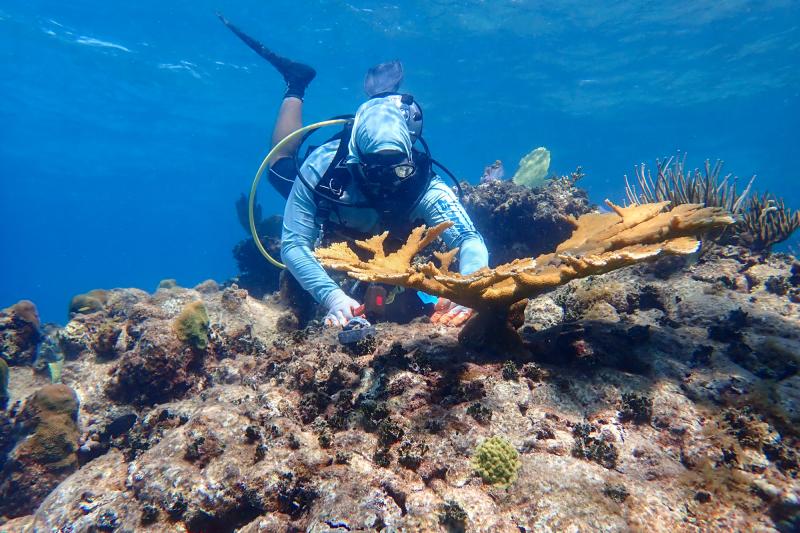
Earlier this year, Sea Ventures coral biologist Manuel Nieves returned to a restoration site off Fajardo, Puerto Rico, to check on outplanted corals. As he descended, he saw bright orange, the color of healthy elkhorn coral, or Acropora palmata. The tips of the branching elkhorn were white, a sign the coral was growing. Outplanting plots from last year and new ones planted this year were connecting, forming a wall of flourishing elkhorn.
“When you look at the areas where no restoration has happened, you see some young corals every now and then,” said Nieves. “But when you see the areas where we’ve intervened, you see more corals growing, more fish. It reinforces your sense of purpose. I know I’m not wasting my time with what I’m doing.”
The healthy, growing corals Nieves saw are encouraging signs for a much larger restoration effort now underway. With $5 million in funding from NOAA Fisheries’ Office of Habitat Conservation, Sea Ventures is restoring 30,000 square meters of coral reef habitat. The area—about the size of 5 and a half football fields— is located on Cayo Largo, a reef off Puerto Rico’s east coast.

Sea Ventures and NOAA have been restoring Cayo Largo since 2018. Some of those earlier outplants have grown large enough to provide coral fragments for new restoration elsewhere on the reef. Healthy natural elkhorn thickets also remain in other areas.
Those indicators became particularly significant after the marine heat waves of 2023 and 2024. Elkhorn populations at some restoration sites in southwestern Puerto Rico suffered catastrophic losses. At Cayo Largo, natural and restored elkhorn fared much better. Scientists do not yet know why. Genetics, local environmental conditions, or other factors could have played a role. The surviving corals are one reason Cayo Largo offers promise for expanded restoration.
Read the full article here: Large-Scale Coral Restoration Underway on Puerto Rico’s Cayo Largo