Large-scale Marine Debris: 4 Ways to Clean up the Big Stuff

By fisheries.noaa.gov, fisheries.noaa.gov.

Marine debris is a challenging problem.

Across the country, NOAA and partners remove everything from lost fishing gear tangled on the seafloor to sunken vessels, abandoned tire reefs, and other trash that have become hazards to navigation and marine ecosystems in the ocean and Great Lakes.

Beginning in 2013, NOAA and its partners began to take on the removal of larger-scale marine debris  that is beyond what is considered typical — this includes the removal of abandoned vessels, barges, piers, and other debris that can remain in the environment for decades. Doing so improves vessel navigation, supports the fishing and tourism economy, helps communities recover from disasters, and prioritizes productive and safe shorelines and waterways across the United States.

To date, more than 50 million pounds of large-scale marine debris has been taken out of marine environments.

But clearing large-scale and bulky debris can present big challenges depending on where it is located and what it is made of.

Let’s peek into 4 techniques that NOAA and our partners use to keep our marine environments free of debris:

1. Gear recovery from seafloor to sea surface

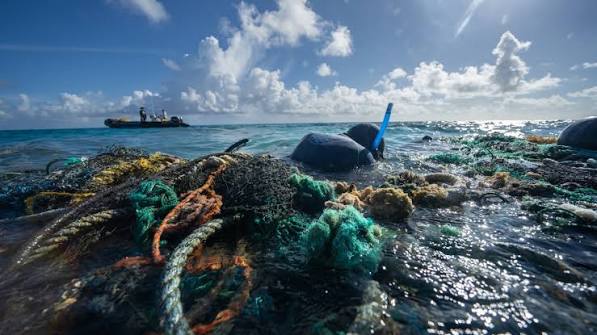
Divers carefully cut fishing gear free from other gear or natural structures before attaching red flotation devices, known as lift bags, to float the debris to the surface during removal operations in the Florida Keys
Divers carefully cut fishing gear free from other gear or natural structures before attaching flotation devices, known as lift bags, to float the debris to the surface during removal operations in the Florida Keys in 2020. Lost and abandoned fishing gear, often called ghost gear, can continue trapping marine life long after it enters the environment. Nets, traps, and lines frequently become tangled on reefs, kelp, rocks, and the seafloor, making them difficult to retrieve. In deeper waters, remotely operated vehicles can help crews locate and recover gear that would otherwise remain out of reach. (Image credit: Sean Davis/National Marine Sanctuary Foundation)

2. Heavy machinery for heavy lifting
An aerial view of a partially sunken bridge being lifted by a crane in Neah Bay, Washington.
A partially sunken bridge is lifted by a crane in Neah Bay, Washington. Formerly a floating bridge, this structure was previously part of the Interstate 90 near Seattle and brought to the Makah Tribal Marina for a construction project. Sunken barges, abandoned vessels, derelict piers, and aging marine infrastructure can be major navigation hazards; can weigh hundreds of tons and degrade significantly in the water; and may contain pollutants, such as fuel, paint, and heavy metals. Removal of this heavy debris often requires cranes, salvage vessels, engineers and months of planning to safely remove from the water. (Image credit: Howard Shack, Toolbox Pictures/National Marine Sanctuary Foundation)

Read the full article here: Large-scale marine debris: 4 ways to clean up the big stuff

Originally  published on 07 October, 2026.