Twin Suzuki 300s Bring Big-Boat Power to the Aspen C128
Outboard power is more popular than ever, and Suzuki has options for a wide range of boats including larger cruisers like the Aspen C128
By Capt. Arnie Hammerman for US Harbors
Outboard engines have come a long way from their humble beginnings. Today’s models are quieter, more fuel-efficient, and more powerful than ever—qualities that have made them increasingly popular across a wide range of boats.
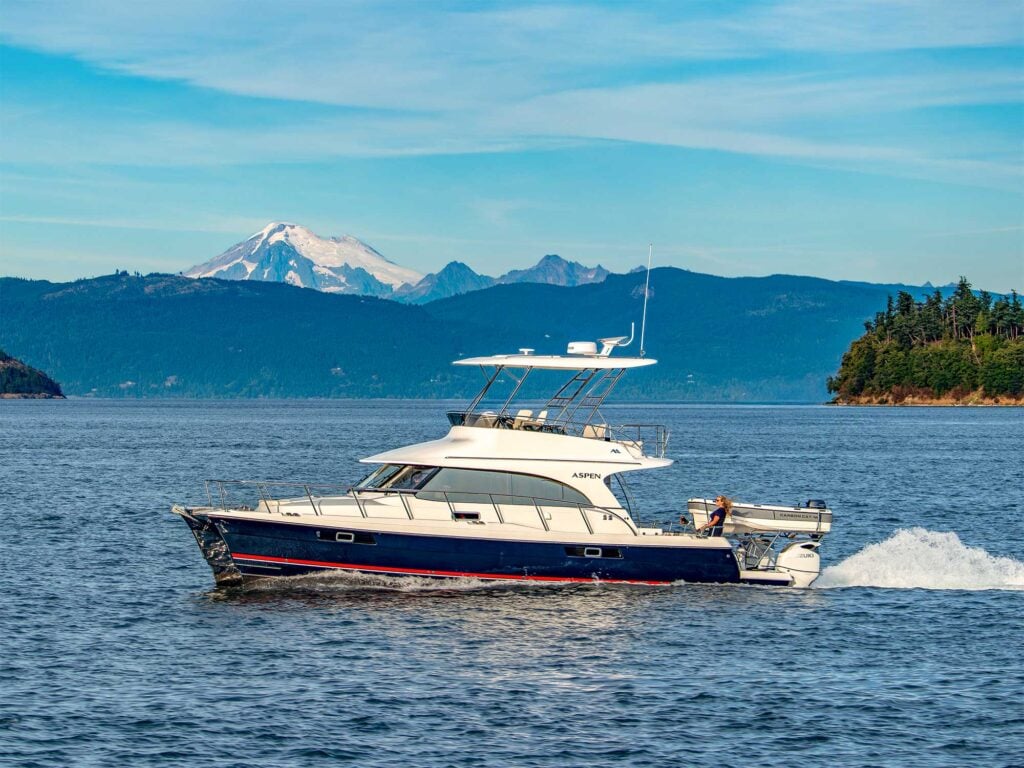
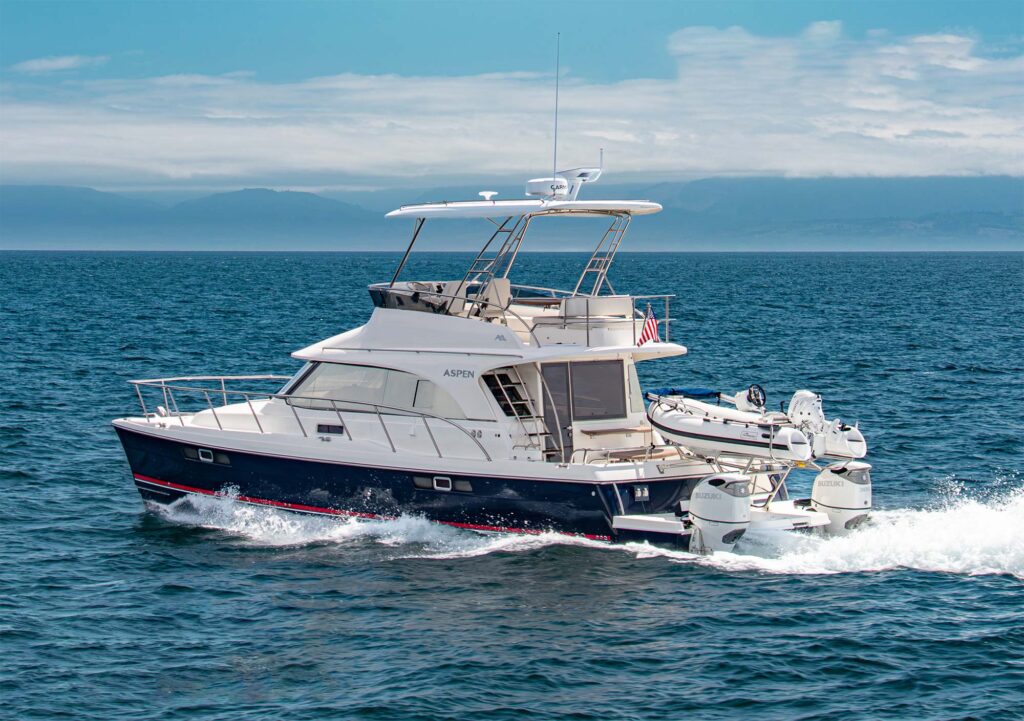
I recently tested a new outboard driven Catamaran, the Aspen C128 which is powered by twin Suzuki 300HP Outboards. At 44’ long the Aspen is a substantial cruiser with three cabins, two heads, a large cockpit, and a flybridge that includes a second steering station and a lounge with a dining table.
Soon after taking delivery, the new owners of hull number one joined other Aspen owners for a multi-week voyage departing from Anacortes, Washington. Instead of sticking to the sheltered San Juan Islands, they headed west through the Strait of Juan de Fuca to explore the rugged coast of Vancouver Island, British Columbia.
After enjoying a northwest shakedown cruise, the owners are bringing their new C128 to the east coast where they have plans for extensive cruising from the Chesapeake and the Carolinas to Florida and the Bahamas.
A New Breed of Outboard Cruiser
Aspen, and the owners of the first C128 chose Suzuki engines for two key reasons: reliability and power.
Suzuki outboards are known for their advanced engineering and dependable performance—essential for offshore adventures and also, as we discovered, long-distance cruising. The 4.4-liter V6 engine block of the Suzuki DF300B delivers more torque than other 300-horsepower outboards, which typically have smaller engine displacements. The Suzuki 300B uses the same block as their higher-horsepower DF350A, giving the 300 an oversized block that excels when driving a 24,000lb boat like the Aspen C128.
Suzuki also uses a dual-propeller system that significantly reduces prop slip and distributes engine power over six blades instead of three. This creates superior “grip” on the water and strong mid-range acceleration. The force produced by each engine is also balanced by the dual-props, which improves maneuverability at low speeds, making it ideal when docking.
The Aspen Hull form runs well at any RPM
The C128 like all Aspens has a unique patented PROA cat hull. One hull is a third thinner than the other hull which means less resistance that translates into better fuel economy. Both hulls have a narrow entry forward that slices through the water and is then directed aft through the tunnels and off to the sides creating very little wake. The boats don’t plane so there is no hump to get over. Running the twin Suzukis up from idle to wide open throttle the engines simply accelerate smoothly and evenly up through the RPM range. I was able to choose any speed I wanted including mid-range speeds that many outboard powered boats have trouble with because they are either trying to get up on or are falling off of plane. The inclinometer I used to gauge bowrise never rose above 2 degrees and I didn’t need to trim the Suzukis.
Onboard with Suzuki power
After the C128 returned from its Vancouver Island voyage, I went aboard to see how it performed firsthand. The 44-foot Aspen C128 has a 13’11” beam—narrow enough to fit in most standard slips, unlike many catamarans of similar size. When I arrived at Cap Sante Marina in Anacortes, WA, the boat was tucked into slip F4 near the end of the dock. With another vessel tied along the bulkhead in the EF-X slip, there was barely enough room to turn the Aspen around.
What I found was impressive. The twin counter-rotating Suzuki propellers, combined with the wide engine spacing of the catamaran design, made the outboards behave like a pair of inboards with much larger propellers. At slow speeds I could work the throttles independently to pivot the boat precisely within its own footprint providing exceptional dockside control. The C128 also has a bow thruster, a welcome addition when pinned to a dock by wind, but on this calm day it wasn’t needed. Using only the Suzukis, I was able to spin the boat effortlessly in either direction.
The twin Suzukis had plenty of power as we accelerated from 0-20mph in 9.5 seconds, quick for a sizeable cruiser like the C128. Wide open at 5,700RPM we hit a peak speed of 30.5mph. Even when pushed like this to full throttle the big Suzukis just hummed along reassuringly. Slowing, I paced the boat back and forth conducting reciprocal runs. At a 20mph fast cruising speed fuel burn was 21.4 gph, just under a mile per gallon. At that speed, with the optional 300-gallon expedition tanks aboard the Suzukis can drive the C128 over 250 miles and still have a 10% fuel reserve. Most outboards like to run at high RPMs and the Suzuki 300s are no different. They seem to purr along over 4,500 RPM and push the boat up over 25 mph easily. Taking tight high-speed turns (2-3 boat lengths at 26 mph) the power available from the outboards was evident as the vessel felt controlled and only lost a little speed. There was also no discernable side slip or cavitation.
Long range cruising
Aspens are designed for long range cruising so during our test we were equally interested in performance numbers delivered by the Suzukis at more moderate speeds. At a slow cruise speed of 8 mph the range jumped to 462 miles. That means that remote areas can be safely accessed, taking advantage of the efficiency of the Aspen design powered by the modern Suzuki outboards.
One engine test
Since the Suzuki 300s have plenty of torque and dual counter-rotating props, we decided to see how the C128 would perform on just one engine. With both engines still in the water, I powered up a single 300 and eased the throttles forward. The boat tracked straight and steady, maintaining good control while gaining noticeable range.
Powering up only one of the twin Suzuki 300s (both were in the water) we ran at a slow cruising speed of 7.9 mph. Compared to running at this same speed with both engines, range using one engine improved by 117 miles to 579 miles with a 10% reserve.
Running on a single 300HP Suzuki extended range to nearly 580 miles—remarkable efficiency for a 44-foot cruiser.
Performance on one engine wasn’t limited to trawler speeds either. A single Suzuki 300 drove the boat fine and even achieved a top speed of 16mph/4,000RPM, and at 11mph, the range was 261 miles proving that one engine mode can save fuel and allow you to explore further with confidence. If one engine fails or a prop fouls, the other can bring the boat home safely, giving you peace of mind for long passages.
Sea Trial Performance Data
Aspen C128 equipped with twin Suzuki DF300Bs (4.4L V6) and dual three-blade stainless props:
- Acceleration: (0–20 mph): 9.5 seconds
- Top speed: (WOT, 5,700 RPM): 30.5 mph
- Fuel Economy: 21.4 gallons per hour @ 20 mph — roughly 1 mpg
- Cruising Range: 250-miles @ 20 mph with 10% reserve on 300 gallons
- Economy cruise: (8 mph): 462-mile range
- Single-engine cruise (7.9 mph): 579-mile range
- Single-engine top speed: 16 mph at 4,000 RPM
Conditions during the trial were calm, but I never doubted how the boat would behave if the weather turned, in part because of my experience driving other Aspen models in rougher conditions. Feedback from the owner’s recent trip spoke to the boat’s seakeeping capabilities as they experienced large waves and high winds. The boat handled well and the twin Suzuki 300s delivered the power and reliability needed to inspire trust even during adverse conditions.
Running with only one engine to extend your range is a unique capability. In our test we found that one engine mode saved fuel allowing further exploration. Knowing that a single engine can bring the boat home safely and efficiently is exactly the kind of reassuring redundancy you want when you are seriously cruising.
Suzuki at 60: Steady Progress on the Water
Suzuki has developed a strong reputation in the United States for making quality outboards. Their dedication to the marine marketplace has been long established. In fact, 2025 marks the 60th anniversary of Suzuki producing and distributing outboard motors.
To stay closer to its customers, Suzuki Marine USA recently moved its headquarters to Tampa, Florida, and opened a technical center in Panama City. It’s a practical decision—most of the country’s outboard-powered boats are in the Southeast, and being nearby means faster service and better communication with both owners and boatbuilders.
Suzuki currently produces outboards from 2.5 to 350 horsepower. Their all 4-stroke line-up is engineered to provide boaters with clean burning, fuel efficient, reliable outboard power that works well on a variety of boats – for fishing, recreation, and workboats. Their mid-to-high horsepower models like the DF300BMDs on the Aspen are designed to work well even on larger cruising boats.
After a day running the Aspen C128, it was clear that this pairing of hull design and outboard power makes sense. The boat handled cleanly at every speed—steady in turns, predictable when docking, and efficient over long runs. The C128’s hull form and the thrust produced by the Suzukis seemed well matched, even when pushing through light chop or carving tight turns at cruising speed. During slow maneuvers, the engines responded instantly, giving the boat a level of control that made docking feel easy.
When I eased the throttles forward for one last run, the Suzukis came to life with that familiar, even hum—strong and smooth. It wasn’t a sound that demanded attention; to me it was the sound of confidence.
For more information about the C128, visit Aspen Catamarans
For more information about the Suzuki 300, visit Suzuki Marine