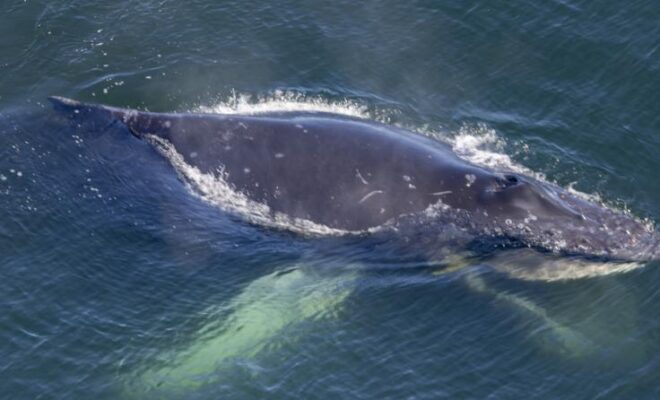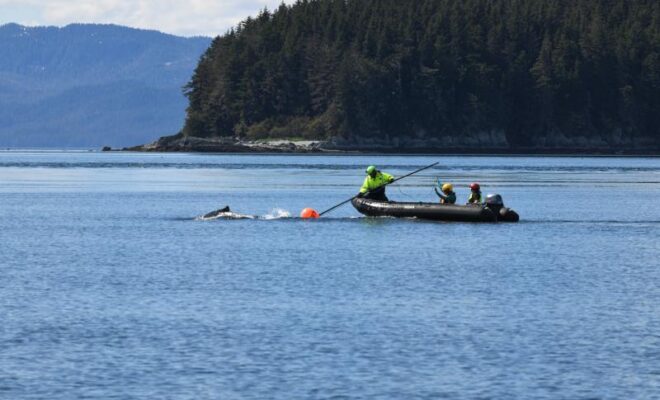
A researcher in a U.S. Coast Guard helicopter first spotted the entangled humpback anchored to the bottom about 20 miles off the Oregon Coast. The whale’s white pectoral flipper extends underwater to the lower left, while white baleen outlines its open lower jaw at bottom right. The entanglement left the whale’s mouth stretched permanently open, making it unable to feed. Photo collected in partnership with Oregon Coast Aquarium, Oregon State University Marine Mammal Institute and Cascadia Research Collective.

Fishing Vessel Joins Trained Team to Free Injured Humpback Whale 20 Miles off Oregon Coast

8/16/2026 - By fisheries.noaa.gov, fisheries.noaa.gov. An Oregon team joined by experts from Washington and a local fisherman freed a severely entangled humpback whale about 20 miles off the Oregon Coast on July 26. While the team removed all of the gear from the whale, the entanglement left the young whale’s jaw permanently… SEE MORE
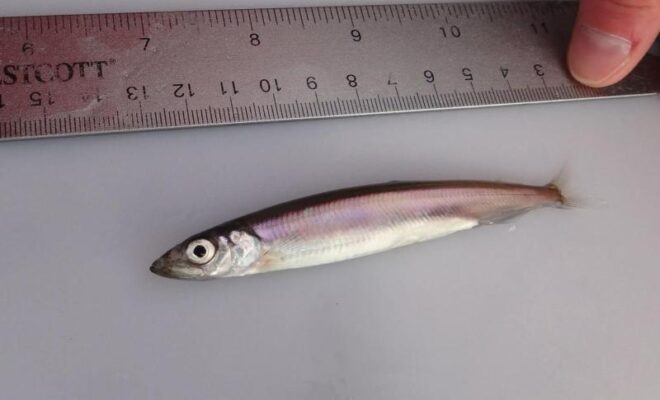
Pacific capelin with unknown maturity. Scientists make microscopic observations to determine if capelin spawn only once or if they are capable of spawning over multiple years. Credit: NOAA Fisheries

NOAA Scientists Discover Repeat Spawning in Pacific Capelin

8/12/2026 - By fisheries.noaa.gov, fisheries.noaa.gov. For certain fish species, like Pacific salmon, reproduction is a once-in-a-lifetime event, known as semelparity. Many other fish are iteroparous—meaning they can spawn repeatedly throughout their lives. New research by NOAA’s Alaska Fisheries Science Center reveals the first evidence that Pacific capelin can be repeat spawners. Over the past decade,… SEE MORE
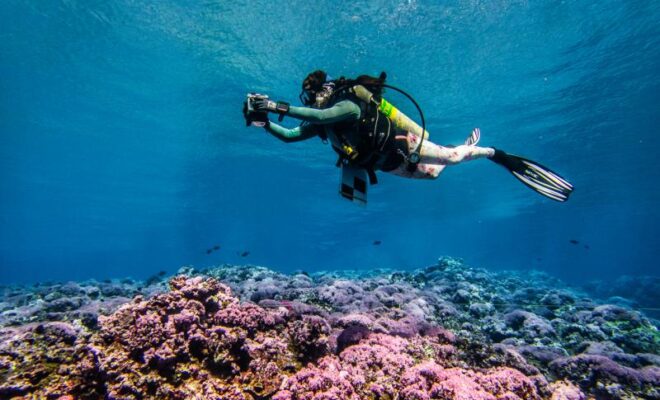
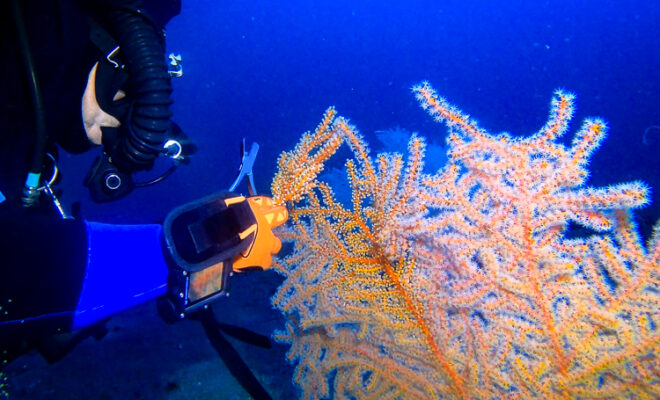
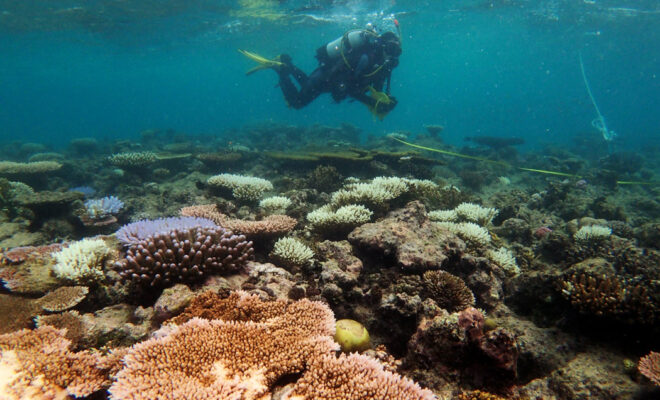
Divers propagating mesophotic coral fragments to start new colonies

Deep Diving and Innovation to Restore the Gulf’s Mesophotic Corals

7/30/2026 - By fisheries.noaa.gov, fisheries.noaa.gov. Deep in the Gulf of America lies a vital but little-known habitat. In the "mesophotic" (middle light) zone are coral ecosystems that are essential to the Gulf’s food web. In 2010, the Deepwater Horizon oil spill injured extensive areas of this delicate environment. Today, scientists across federal agencies and… SEE MORE
Coral bleaching at Cheeca Rocks in the Florida Keys in 2023. [Credit: NOAA]

World’s Fourth Mass Coral Bleaching Event Likely Ended in 2025

6/7/2026 - By nesdis.noaa.gov, nesdis.noaa.gov. After analyzing satellite data and bleaching observations, NOAA’s experts say the record-breaking fourth global coral bleaching event likely concluded in mid-2025. The fourth global coral bleaching event was confirmed by NOAA on April 15, 2024. From early-2023 to mid-2025, bleaching-level heat stress impacted 84% of the world’s coral… SEE MORE