Spring Outlook: Drought Forecasted to Expand in U.S. West, Parts of Plains
By noaa.gov, noaa.gov.
Drought conditions are forecast to worsen or develop for many areas in the West and south-central Plains, according to NOAA’s Spring Outlook released today for April through June. Forecasters from NOAA’s National Weather Service also predict above-normal temperatures for the majority of the U.S.
“Factors influencing NOAA’s Spring Outlook include the El Niño-Southern Oscillation (ENSO), low snowpack in the West and soil moisture content throughout the lower 48 states,” said Ken Graham, director of NOAA’s National Weather Service. “This spring will also feature a transition from La Niña to ENSO-neutral conditions, meaning neither El Niño nor La Niña.”
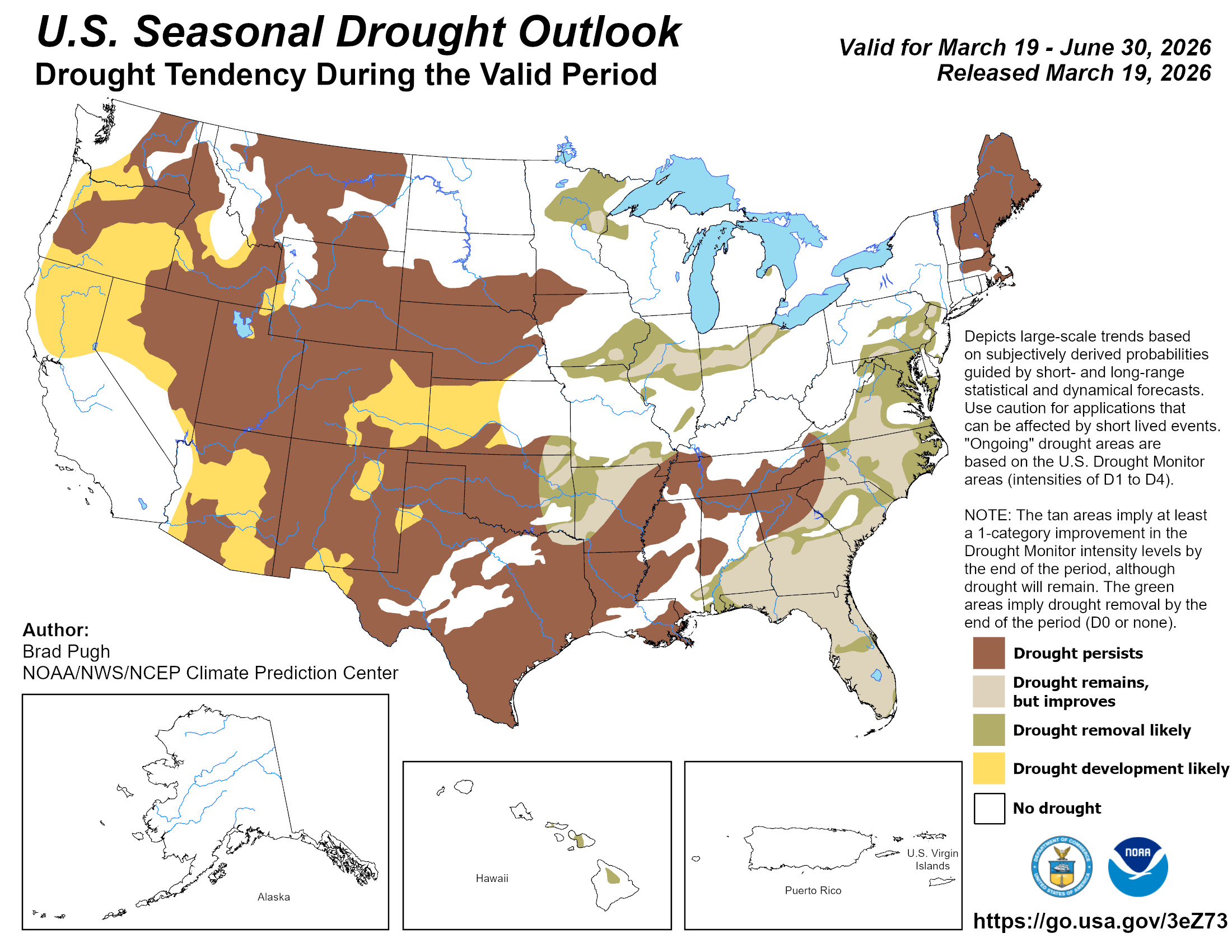
“Drought conditions worsened or developed for much of the Great Plains, Lower Mississippi Valley, and Southeast U.S. due to warmer and drier than normal conditions this winter,” said Jon Gottschalck, chief of the Operational Prediction Branch, NOAA’s Climate Prediction Center. “Drought is likely to persist across much of the West while developing in parts of the Pacific Northwest, Great Basin, central Rockies and Southwest. Dry conditions are expected to improve for some areas in the Midwest and Atlantic seaboard.”
Temperature and precipitation outlooks
The temperature outlook for April through June shows above-normal temperatures are favored across the majority of the western U.S. eastward to include much of the Plains, the lower and middle Mississippi Valley, the Ohio Valley, the Tennessee Valley, the Southeast and the southern Mid-Atlantic.