A Hurricane Season Without Hurricanes, So Far
By US Harbors
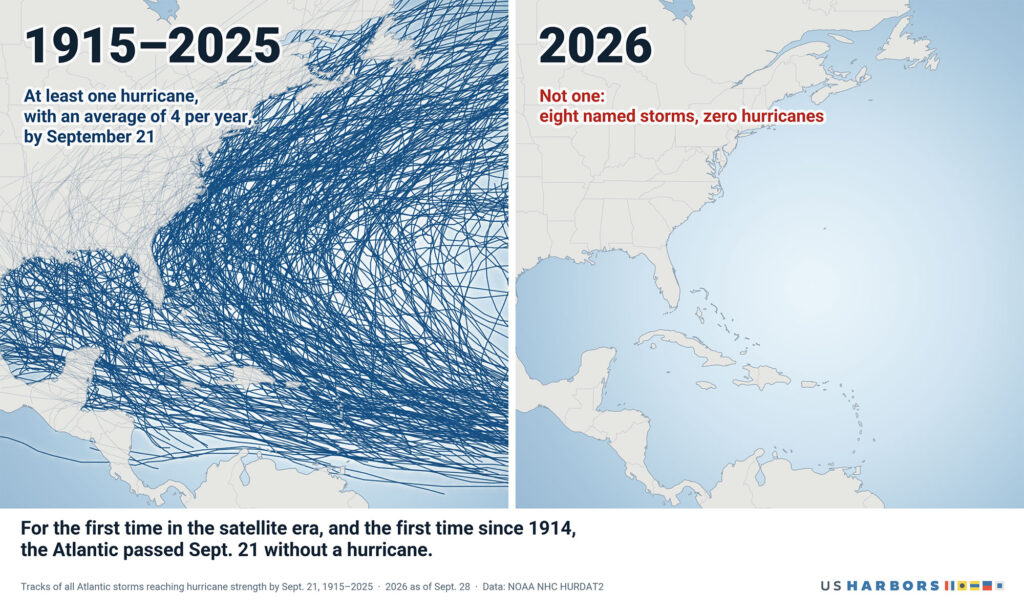
Every Atlantic hurricane season from 1915 through 2025 produced at least one hurricane by September 21, and most produced about four. This year has produced none. Tropical Storm Hanna, the season’s eighth named storm, formed this week far east of Bermuda and is expected to stay a tropical storm.
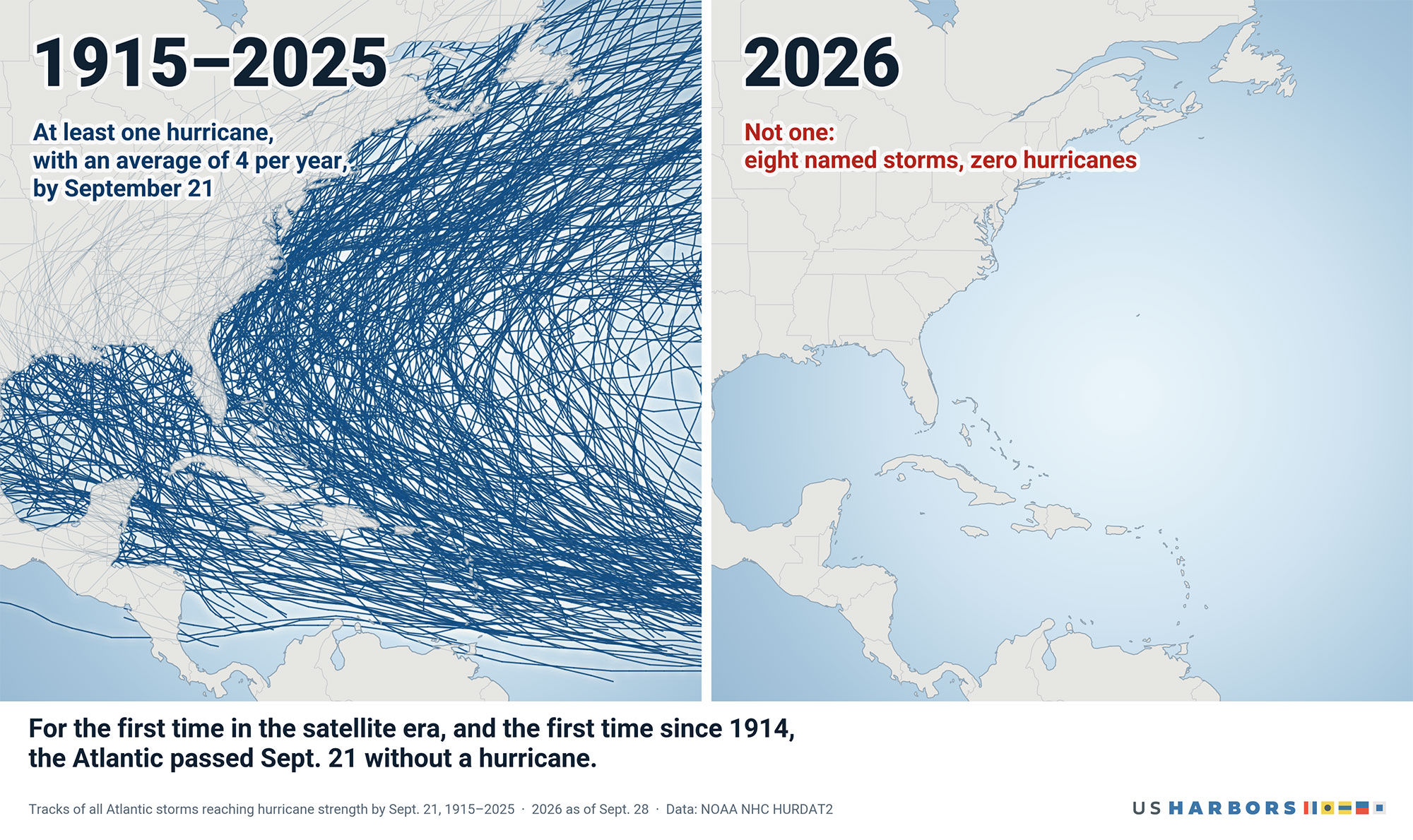
The map above shows every storm that reached hurricane strength by September 21 across those 111 seasons, 432 tracks in all, beside the 2026 Atlantic. This season has now gone longer without a hurricane than any since weather satellites began tracking storms in 1966. Unless something forms in the next two days, it will also be the first September without an Atlantic hurricane since 1994.
By total storm energy, a measure that combines strength and duration, 2026 is the quietest Atlantic season on record through late September going back to 1950. In 2004, that figure was more than 30 times higher by the same date.The cause lies in the Pacific. Waters off South America have run nearly 3°C above average, one of the strongest El Niño events on record. El Niño shifts atmospheric patterns in ways that make the Atlantic hostile to storm growth, and this year stable, dusty Saharan air added to the effect. The same pattern has fueled the Eastern Pacific, which tied the record for Category 5 hurricanes in a single season.
“It’s not really the rain causing all of the flooding issues here on Lakeshore Drive, it’s just all the water being pushed in by Bertha up and over the seawall and crashing in,” – AccuWeather Correspondent, Bill Wadell
Forecast models show no significant development for at least the next 10 days, but hurricane season runs through November 30. If it ends without a hurricane, 2026 will join 1907 and 1914 as the only such seasons on record. A slow start does not rule out a late-season storm, and this year has shown that flooding, from rain or from the sea, is often what reaches the harbor first. Check your harbor’s tide chart and our Monthly High Tide Flooding Outlook for upcoming high-tide flooding events. When a storm surge arrives on top of an already high tide, the impact can be severe.
SOURCES
The graphic and the historical record
-
Hurricane tracks, the 1941 record, the average of 4 by Sept. 21, and the “first September since 1994” US Harbors analysis of NOAA hurricane records. Source: NOAA’s HURDAT2 best-track dataset, available from the National Hurricane Center https://www.nhc.noaa.gov/data/#hurdat
-
Satellite-era record and the 1907/1914 comparison: WBTV (Sept 28)
https://www.wbtv.com/2026/09/28/hurricane-less-season-off-record-start-atlantic-what-know/
Current season status
-
Hanna as the eighth named storm, and the 1907/1914 framing: CBS17:
https://www.cbs17.com/weather/tracking-the-tropics/eighth-named-storm-of-2026-atlantic-hurricane-season-forms/ -
No significant development expected for 10 days: WUSF, (Sept 28)
https://www.wusf.org/weather/2026-09-28/peak-tropical-cyclone-season-to-wrap-up-without-a-hurricane-across-atlantic
Storm energy (ACE) and El Niño
-
Record-low ACE since 1950, and El Niño near 3°C above average: Boston Globe, (Sept 9) https://www.bostonglobe.com/2026/09/09/metro/atlantic-hurricane-season-2026-record-el-nino/
Arthur
-
Under 12 hours, the 1962 record, and the preliminary status: WBRZ:
https://www.wbrz.com/news/historic-deluge-remnants-of-tropical-storm-arthur-shatter-louisiana-s-24-hour-rainfall-record
Bertha
-
Storm surge flooding along the Gulf Coast: AccuWeather:
https://www.accuweather.com/en/hurricane/bertha-makes-2-gulf-coast-landfalls-causes-flooding-and-beach-erosion/1915076
Edouard
-
Flooding in East Texas: Associated Press:
https://apnews.com/article/edouard-texas-storm-marie-lowell-karina-hurricane-aa5eb54efac7113246603f1c40c1a037
US Harbors used an AI model to analyze NOAA hurricane records, and produce the accompanying graphic. All sources and figures were reviewed and verified by US Harbors