By fisheries.noaa.gov, fisheries.noaa.gov.
Aquaculture can sustainably produce seafood to complement wild-caught fisheries. However, like all food systems, aquaculture requires sound science to ensure farmed species don’t harm wild species. Scientists at NOAA’s Southwest Fisheries Science Center are working to understand the genetic risks in offshore aquaculture.
NOAA has identified 21,000 acres in federal waters of the Gulf of America and offshore Southern California as Aquaculture Opportunity Areas. To support this effort, experts developed three science advice publications outlining considerations for genetic risk for offshore aquaculture in these areas.
- Science Advice for Genetic Effects from Macroalgae Aquaculture in Southern California and the Gulf of America
- Science Advice for Genetic Effects from Finfish Aquaculture in Southern California and the Gulf of America
- Science Advice for Genetic Effects from Shellfish Aquaculture in Southern California and the Gulf of America
What is Genetic Risk?
In aquaculture, genetic risk is the potential harm from farmed species interbreeding with wild populations. For example; when farmed fish—the product of generations of domestication—interbreed with wild fish, the offspring tend to be less genetically diverse and evolutionarily fit. As those fish interbreed, the entire wild population can lose evolutionary successful traits and become more vulnerable to changing ocean conditions.
Genetic impacts from aquaculture can happen in several ways.
Escapes
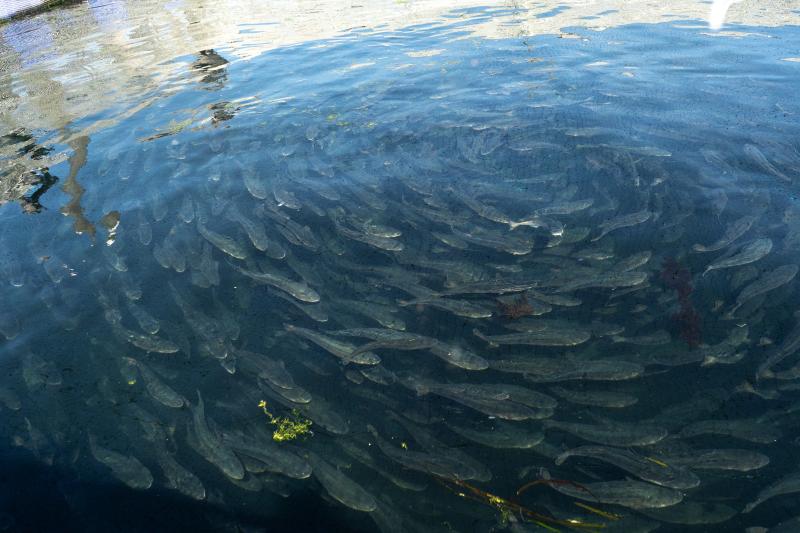
This happens when species escape their containment systems and breed with wild individuals in the marine environment. Escapes can occur slowly (when a few fish wiggle through a hole in a net over time) or catastrophically (when an entire net collapses and releases the fish inside).
Spawning
Many farmed species, such as oysters and clams, are broadcast spawners. That means they release their eggs and sperm, or gametes, into the water. Since gametes are microscopic, they can flow through nets or cages and potentially interbreed with wild populations. This is also a risk for fish that reach sexual maturity before harvest.
Spores
This occurs when seaweeds farmed on longlines reach maturity before harvest and release spores, or when pieces of the seaweed break free into the marine environment. Spores are microscopic and can travel away from the farm site depending on ocean currents.
Fragmentation
During storms or periods of large waves, broken seaweed fragments can carry spore-releasing tissue over even greater distances. Depending on the species, some dislodged fragments may be able to reattach and grow if they find a suitable location. These spores and fragments may settle and grow near or in natural seaweed beds.
Read the full article here: Managing Genetic Risk in Offshore Aquaculture
Originally published on 14 September, 2026.