Diving Into Ghost Shark Systematics: My Summer as a NOAA Hollings Scholar
By fisheries.noaa.gov, fisheries.noaa.gov.
Northeastern University student Lei Curtis reflects on their Hollings internship experience with the National Systematics Laboratory.
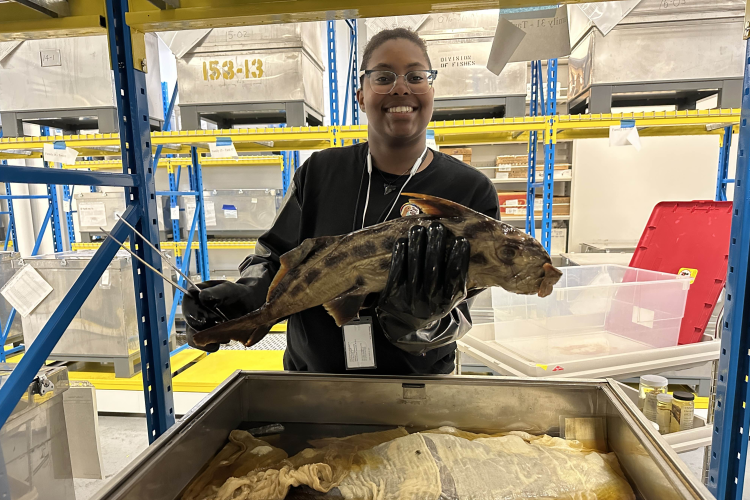
My name is Lei Curtis, and I’m excited to share my experience as a 2025 NOAA Hollings scholar interning with the National Systematics Laboratory. I’m a senior at Northeastern University studying ecology and evolutionary biology. My main research interest is the diversity of marine organisms that have cartilage skeletons, including sharks, rays, and skates. I aspire to continue studying the evolution of these organisms throughout my career. This summer, I got to sharpen my research skills by working with specimens of a group called chimaeras, or ghost sharks.
Why Study Ghost Sharks?
Contrary to their name, ghost sharks are not true sharks—they are actually a group of deep sea animals also known as chimaeras. I was immediately captivated by ghost sharks when I discovered them during my sophomore year of college and made it my mission to learn as much as possible. These animals are poorly understood and understudied because most species are only found in specific locations and deeper environments. As a result, it is difficult to fully understand them without access to physical specimens. My summer 2025 internship supported by the Ernest F. Hollings Scholarship provided the perfect opportunity to study them firsthand.

Read the full article here: Diving Into Ghost Shark Systematics: My Summer as a NOAA Hollings Scholar