Colossal Coral in the Mariana Islands is Largest of its Kind
By oceanservice.noaa.gov, oceanservice.noaa.gov.
Researchers measure 14,500-square-foot coral structure in an underwater volcano.
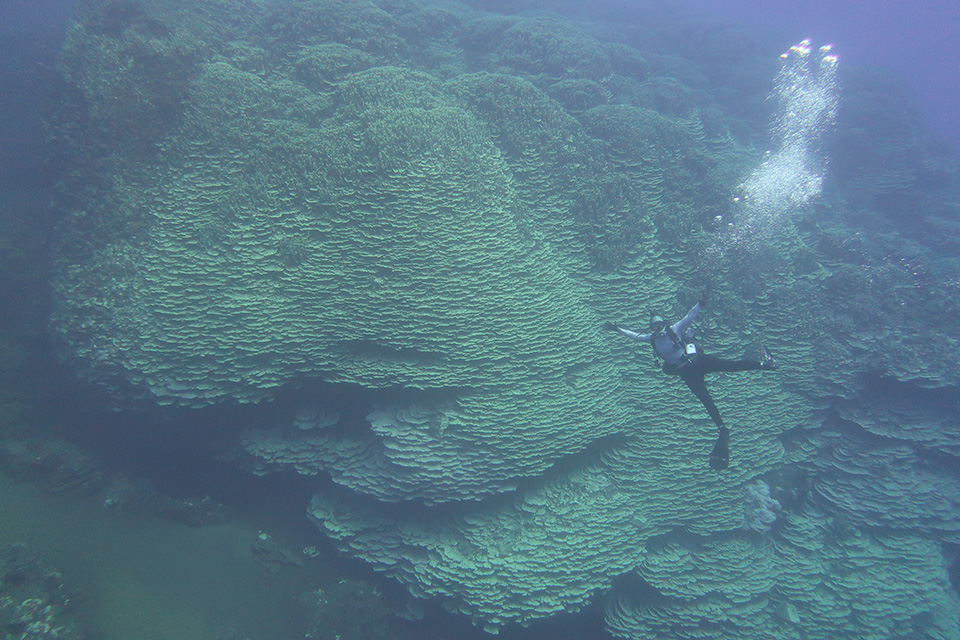
In a time when coral bleaching, disease, and habitat loss are increasingly common, a hidden giant defies the odds. A majestic cathedral-like structure — built by colonies of Porites rus, a species of stony coral — rises from a submerged volcanic caldera in the Maug Islands in the Mariana archipelago.
“This coral was so big, we actually couldn’t easily measure it due to dive safety restrictions,” said Thomas Oliver, Ph.D., a chief scientist of NOAA’s National Coral Reef Monitoring Program.
While the coral’s existence was previously known to locals, NOAA scientists recently had the opportunity to take the first approximate measurements during the 2025 National Coral Reef Monitoring Program surveys.
Measurements suggest the colony covers roughly 14,500 square feet (1,347 square meters) — stretching more than 100 feet (31 meters) across the top and 200 feet (62 meters) at its base. That’s wider than the length of two school buses at the top, and the length of four school buses at the bottom.

“It is difficult to tell the true age of this coral because it doesn’t produce growth bands like other corals,” said Hannah Barkley, Ph.D., a chief scientist of NOAA’s National Coral Reef Monitoring Program. “We roughly estimate that Porites rus grows outward about a centimeter per year, so one could imagine that a colony of that size is pretty old.”
At that rate, the coral could be more than 2,050 years old!
It is the largest Porites coral ever reported — measuring approximately 3.4 times larger than the massive Porites coral colony reported in 2020 in American Samoa. Size isn’t the only impressive thing about this Porites rus, so is its age.
“It is difficult to tell the true age of this coral because it doesn’t produce growth bands like other corals,” said Hannah Barkley, Ph.D., a chief scientist of NOAA’s National Coral Reef Monitoring Program. “We roughly estimate that Porites rus grows outward about a centimeter per year, so one could imagine that a colony of that size is pretty old.”
At that rate, the coral could be more than 2,050 years old!


A unique underwater home
While this coral certainly is special, so is its home in the Maug caldera, which lies within the Mariana Trench Marine National Monument. The Maug caldera has intrigued scientists trying to protect the ocean for decades — from sea floor mapping expeditions in 2003, in-depth ocean chemistry studies in 2014, as well as the coral reef monitoring program’s visits in 2017, 2022, and 2025.
The caldera is known as a “natural laboratory” because of its unique carbon dioxide vents. In one area gas bubbles up from the vents and creates acidic oceanic conditions, allowing scientists to study how organisms, like coral, may respond to these conditions in the future. Notably, the acidic conditions only impact habitats within a few meters of the vents, and do not impact the massive coral thriving just a few hundred meters away.
“It is remarkable to see both these extremes — a resilient and thriving mega coral, and a dead zone near the carbon dioxide vents — in the same area. Maug is truly such a special place,” said Barkley.