NOAA Satellites Helped Rescue 300 People in 2025
By noaa.gov, noaa.gov.
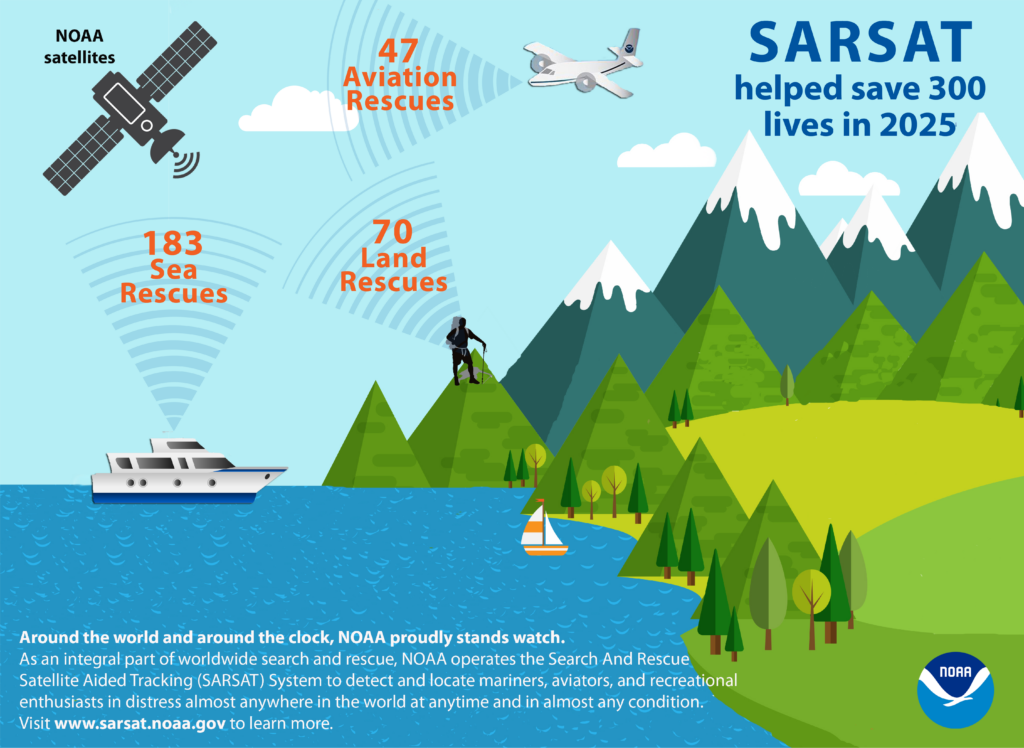
From an injured skier in the Rockies to a disabled catamaran in the Atlantic Ocean, NOAA’s satellites were pivotal in helping rescue 300 people from life-threatening situations in the U.S. and its surrounding waters in 2025.
Of the rescues last year, 183 people were pulled from the water, 47 were saved from aviation incidents and 70 were rescued on land. Florida had the most people rescued (71), followed by Alaska (28) and Wyoming (21).
The same polar-orbiting and geostationary satellites that help meteorologists issue life-saving forecasts are also part of the global Search and Rescue Satellite Aided Tracking system, or COSPAS-SARSAToffsite link. Since its beginnings in 1982, COSPAS-SARSAT has been credited with supporting more than 63,000 rescues worldwide. This includes more than 11,190 rescues throughout the U.S. and its surrounding waters as part of the U.S. Search and Rescue Satellite Aided Tracking system known as SARSAT.
This system uses a network of U.S. and international spacecraft to detect and locate distress signals from 406MHz emergency beacons onboard aircraft, boats and handheld Personal Locator Beacons (PLBs) anywhere in the world.
How it works: When a distress signal is received by the SARSAT Mission Control Center at NOAA’s Satellite Operations Facility in Suitland, Md., the information is immediately sent to rescue coordination centers, operated either by the U.S. Air Force for land rescues or the U.S. Coast Guard (USCG) for maritime rescues. NOAA also supports rescues globally by relaying distress signal information to international COSPAS-SARSAT partners.