Can Habitat Restoration Help Salmon Recover? Prairie Creek Offers Clues
By fisheries.noaa.gov, fisheries.noaa.gov.
This story is part 2 of a 2-part series. Read part 1.
When any habitat restoration project finishes, a critical question remains: Will the project help threatened fish and other species recover? Answering that question requires rigorous long-term monitoring.
At the Prairie Creek salmon habitat restoration project in Northern California, researchers have conducted monitoring before, during, and after construction. The monitoring will determine whether the project would improve the survival prospects of threatened Southern Oregon/Northern California Coast coho salmon. Researchers included NOAA Fisheries’ Office of Habitat Conservation, Cal Poly Humboldt, and other partners
The project transformed a former lumber mill site into wetlands, side channels, and off-channel ponds where juvenile salmon can rest, feed, and grow before migrating to the Pacific Ocean. Juvenile salmon that grow big and strong in freshwater have a better chance of surviving their time in the ocean and returning as adults to spawn.
Early findings suggest that juvenile coho salmon using the restored habitat are growing faster and experiencing higher ocean survival than prior generations from the same watershed. Preexisting monitoring data going back to 2011 gave the team an unusually long baseline against which to measure change. Their findings are also changing what scientists understand about how juvenile salmon use coastal watersheds.

Monitoring: Early Signs of Success
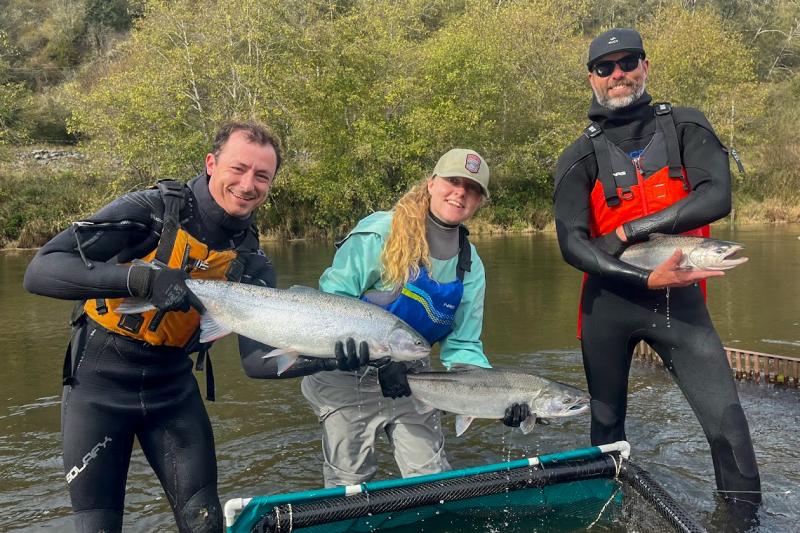
Researchers from Cal Poly Humboldt set up a salmon life-cycle monitoring station to determine how coho salmon and other species were responding to the project.
Each fall, team members wade into Prairie Creek, catch a sample of juvenile coho salmon, measure them to assess growth rates, and implant them with Passive Integrated Transponders, or PIT tags. These microchips are the size of a grain of rice, and last for the fish’s lifetime. They are detected by antenna arrays placed at strategic locations throughout the watershed, automatically logging each fish’s location and timing. The team also counts redds, or salmon nests, during the winter spawning season and counts smolts, juvenile fish heading to the ocean, each spring.