Restoring California’s Prairie Creek Supports Salmon Recovery and Local Community
By fisheries.noaa.gov, fisheries.noaa.gov.
This story is part 1 of a 2-part series. Read part 1.
For more than a decade, NOAA Fisheries and a broad coalition of partners worked to transform degraded fish habitat on California’s Prairie Creek into a thriving floodplain ecosystem for juvenile salmon and steelhead.
Located in California’s redwood country, Prairie Creek is part of the Redwood Creek watershed and one of the last refuges for three threatened species:
Coho salmon populations along the California coast have declined by an estimated 90 to 95 percent over the last century.
Nearly 98 percent of Prairie Creek flows through Redwood National and State Parks, but its unprotected lower portion bears the scars of a century of livestock grazing, highway construction, and industrial logging. A Yurok Tribe elder described the site, which is part of the Tribe’s ancestral land, as a “festering cut.”
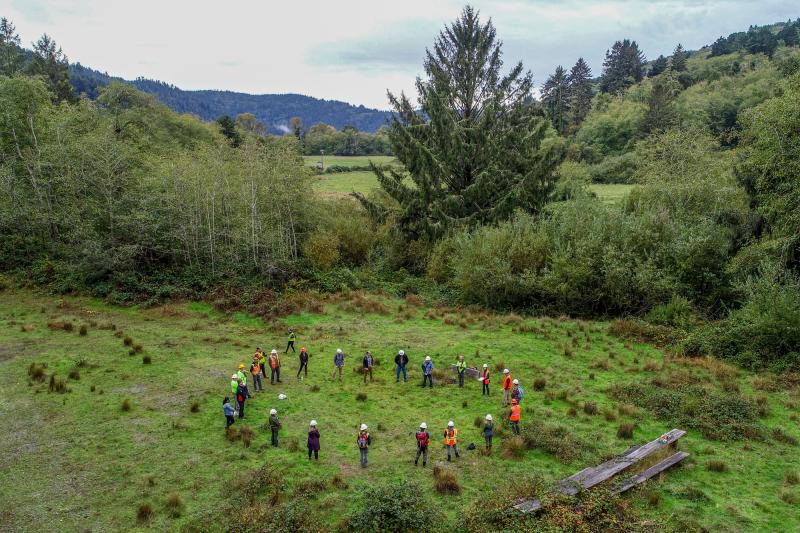
In December 2014, NOAA Fisheries and partner staff gathered at the site just off Highway 101 in Orick, California. They found an expanse of asphalt behind a chain-link fence, the remnants of a 125-acre lumber mill that had operated for nearly 50 years before closing in 2009. Prairie Creek flowed in a deeply entrenched channel with 10- to 12-foot vertical banks. Virtually no salmon habitat remained at the site, and there was very little downstream on Redwood Creek, which is lined with flood-control levees all the way to the Pacific Ocean.