Charting the Future of Fisheries-Independent Surveys

By fisheries.noaa.gov, fisheries.noaa.gov.

Fisheries-independent surveys operate on dedicated survey vessels and are the foundation of sustainable fisheries management. They provide the consistent data on marine resources we need to inform stock assessments. These data are collected using a scientifically rigorous sampling framework and are used to set catch limits. As the ocean environment changes and survey needs evolve, our monitoring approaches must adapt while maintaining the long-term data sets we need.

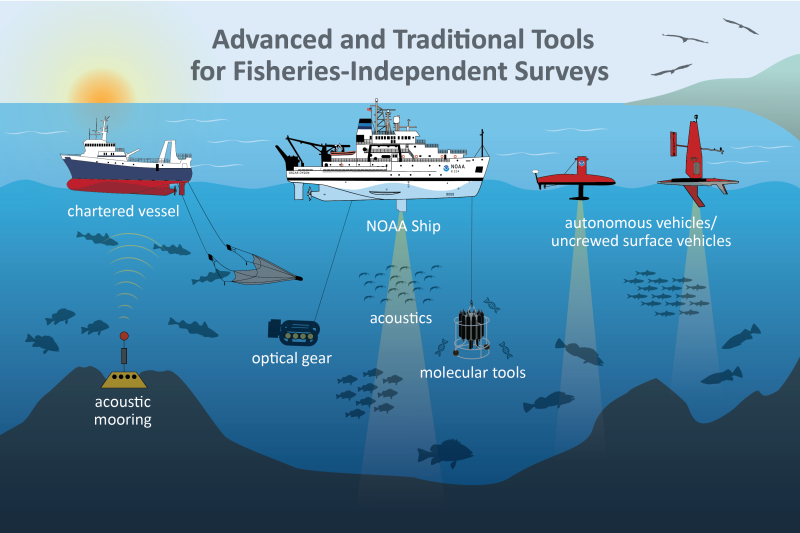
new framework outlines a strategic path forward. Traditional methods include capture-based trawl and hook-and-line together with acoustic sampling from the survey vessel. The future of fisheries-independent surveys lies in the careful, incremental integration of advanced technologies alongside traditional methods.

For example, some complementary survey data can be obtained using additional acoustic, optical, and molecular sampling tools, including from autonomous vehicles and stationary platforms. These advanced technologies generally can’t provide the complete set of data necessary for stock assessment. But they can improve the scale, breadth, and efficiency of surveys.

An international team led by NOAA’s Alaska Fisheries Science Center developed a new framework to outline a strategic path forward for fisheries-independent surveys. Here, a joint U.S.-Canada team deployed a stereo drop-camera rig to survey variable and rocky habitat.
An international team led by NOAA’s Alaska Fisheries Science Center developed a new framework to outline a strategic path forward for fisheries-independent surveys. Here, a joint U.S.-Canada team deployed a stereo drop-camera rig to survey variable and rocky habitat. Credit: NOAA Fisheries/Paul Hillman

The new framework was developed by collaborators from:

  • NOAA Fisheries
  • Earth Sciences New Zealand
  • Washington Department of Fish and Wildlife
  • Institute for Marine Research (Norway)
  • Institut Français de Recherche pour l’Exploitation de la Mer (France)
Deploying a mooring from a chartered commercial fishing boat. The mooring sits on the seafloor and is outfitted with acoustic transducers that sample the water column for aggregations of fish and invertebrates.
Deploying a mooring from a chartered commercial fishing boat. The mooring sits on the seafloor and is outfitted with acoustic transducers that sample the water column for aggregations of fish and invertebrates. Credit: NOAA Fisheries
Estimated densities of (left) pollock, (center) krill, and (right) jellyfish, based on a new analysis method for acoustic data. The acoustic data is collected over an expanded frequency range to remotely tell different animals apart and estimate their abundance. Credit: NOAA Fisheries