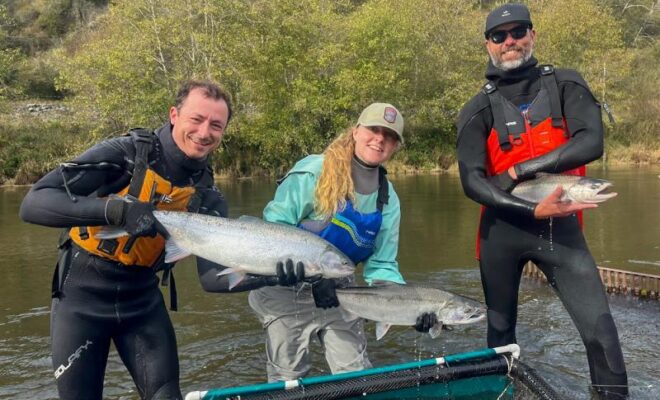
Members of the monitoring show off adult salmon captured at a monitoring station. From left to right, Kevin Vandenack holds a steelhead, Katherine Stonecypher holds a coho salmon, and Bryan Crouch holds a Chinook salmon. Credit: Katherine Stonecypher/Cal Poly Humboldt

Can Habitat Restoration Help Salmon Recover? Prairie Creek Offers Clues

8/18/2026 - By fisheries.noaa.gov, fisheries.noaa.gov. This story is part 2 of a 2-part series. Read part 1. When any habitat restoration project finishes, a critical question remains: Will the project help threatened fish and other species recover? Answering that question requires rigorous long-term monitoring. At the Prairie Creek salmon habitat restoration project in Northern California,… SEE MORE
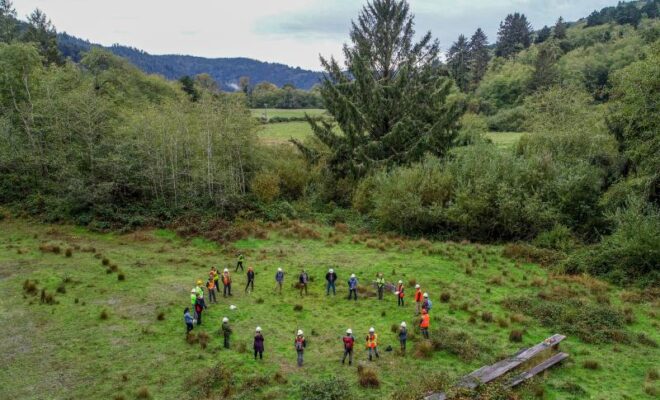
Prairie Creek project partners gather at the restoration site before construction begins. Credit: Michael Weir/CalTrout

Restoring California’s Prairie Creek Supports Salmon Recovery and Local Community

8/17/2026 - By fisheries.noaa.gov, fisheries.noaa.gov. This story is part 1 of a 2-part series. Read part 1. For more than a decade, NOAA Fisheries and a broad coalition of partners worked to transform degraded fish habitat on California's Prairie Creek into a thriving floodplain ecosystem for juvenile salmon and steelhead. Located in California's redwood… SEE MORE
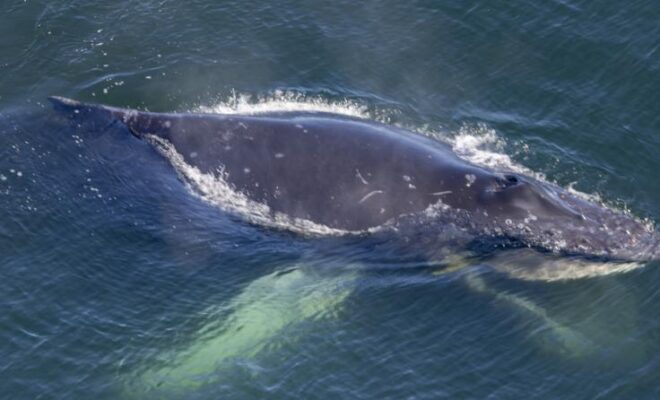
A researcher in a U.S. Coast Guard helicopter first spotted the entangled humpback anchored to the bottom about 20 miles off the Oregon Coast. The whale’s white pectoral flipper extends underwater to the lower left, while white baleen outlines its open lower jaw at bottom right. The entanglement left the whale’s mouth stretched permanently open, making it unable to feed. Photo collected in partnership with Oregon Coast Aquarium, Oregon State University Marine Mammal Institute and Cascadia Research Collective.

Fishing Vessel Joins Trained Team to Free Injured Humpback Whale 20 Miles off Oregon Coast

8/16/2026 - By fisheries.noaa.gov, fisheries.noaa.gov. An Oregon team joined by experts from Washington and a local fisherman freed a severely entangled humpback whale about 20 miles off the Oregon Coast on July 26. While the team removed all of the gear from the whale, the entanglement left the young whale’s jaw permanently… SEE MORE
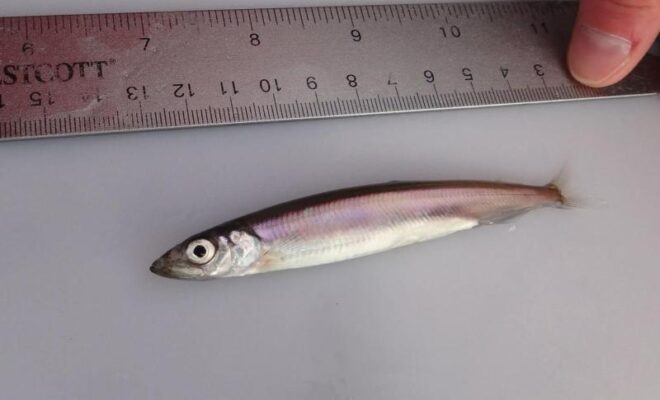
Pacific capelin with unknown maturity. Scientists make microscopic observations to determine if capelin spawn only once or if they are capable of spawning over multiple years. Credit: NOAA Fisheries

NOAA Scientists Discover Repeat Spawning in Pacific Capelin

8/12/2026 - By fisheries.noaa.gov, fisheries.noaa.gov. For certain fish species, like Pacific salmon, reproduction is a once-in-a-lifetime event, known as semelparity. Many other fish are iteroparous—meaning they can spawn repeatedly throughout their lives. New research by NOAA’s Alaska Fisheries Science Center reveals the first evidence that Pacific capelin can be repeat spawners. Over the past decade,… SEE MORE
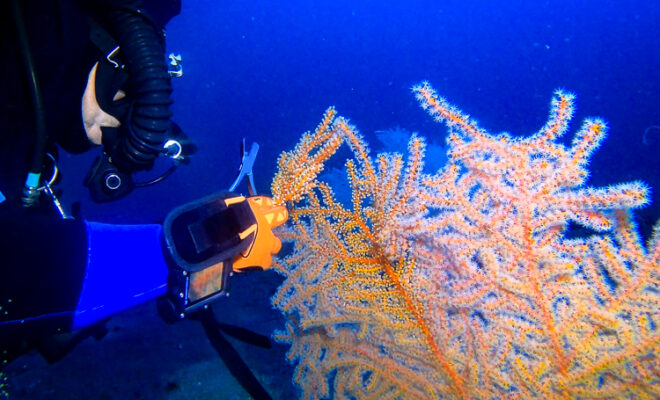
Divers propagating mesophotic coral fragments to start new colonies

Deep Diving and Innovation to Restore the Gulf’s Mesophotic Corals

7/30/2026 - By fisheries.noaa.gov, fisheries.noaa.gov. Deep in the Gulf of America lies a vital but little-known habitat. In the "mesophotic" (middle light) zone are coral ecosystems that are essential to the Gulf’s food web. In 2010, the Deepwater Horizon oil spill injured extensive areas of this delicate environment. Today, scientists across federal agencies and… SEE MORE
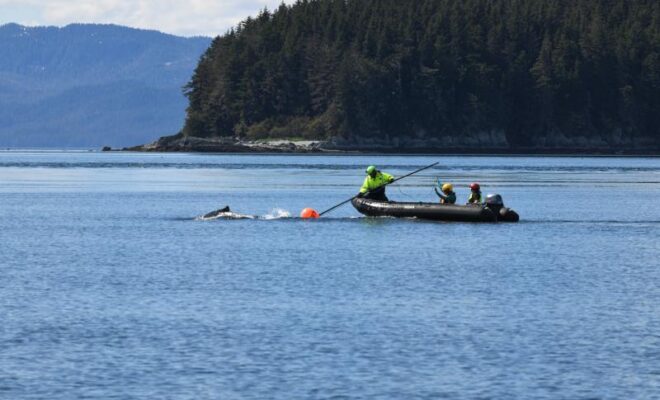
The NOAA Fisheries response team uses poles with specialized knives to cut entangling lines. Credit: Alaska Department of Fish and Game/Jamie Musbach (NOAA Fisheries Permit # 24359)

Humpback Whale Successfully Freed from Entanglement in Endicott Arm

7/26/2026 - By fisheries.noaa.gov, fisheries.noaa.gov. The Tracy Arm-Fords Terror wilderness, located 50 miles south of Juneau, Alaska, features a pair of steep glacial fjords: Tracy Arm and Endicott Arm. While remote, the waters in this area see steady vessel traffic, ranging from massive cruise ships and small charter boats to commercial fishing… SEE MORE
Image Credits: NOAA Fisheries.

Celebrating Habitat Month

7/21/2026 - By Fisheries.Noaa.Gov, fisheries.noaa.gov. July is Habitat Month at NOAA Fisheries! All month long, we’ll be sharing how we conserve and restore habitat to sustain our nation’s fisheries and support coastal communities. NOAA conserves habitats like wetlands, rivers, and coral reefs to support fisheries—but habitat isn’t valuable just for the home it provides for fish and wildlife.… SEE MORE